
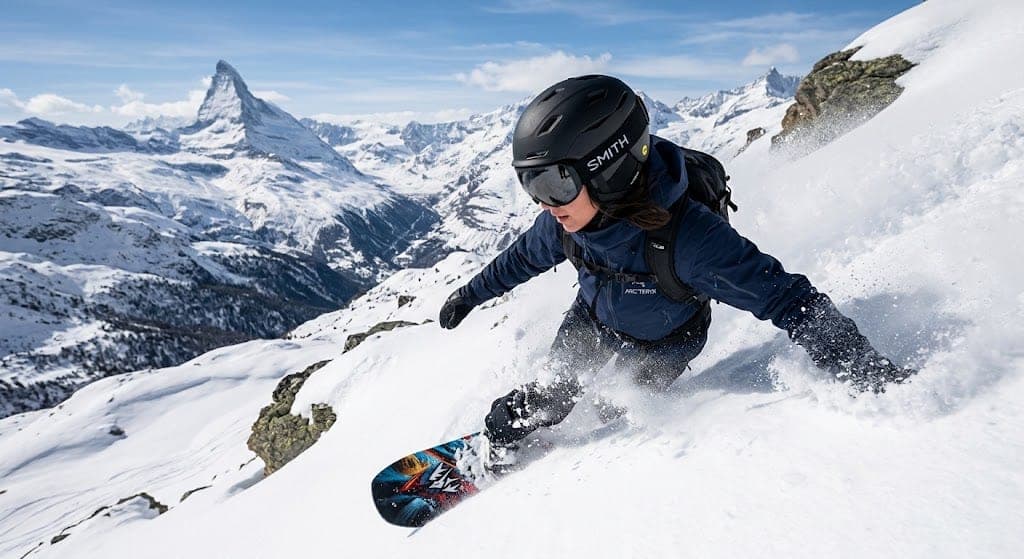
A good helmet is the one piece of your ski or snowboard kit that isn't there to make you better — it's there to protect you when something goes wrong. With the number of models, technologies and certifications on the market today, choosing well can feel more complicated than it should be. This guide pulls together, in one place, everything an informed buyer needs to weigh up: helmet types, how to get the size right, which safety technologies genuinely make a difference, and which standards a certified helmet has to meet.
In short: look for a helmet with at least CE EN 1077 certification, fitted to the exact measurement of your head — not the size you "usually take" in other brands — compatible with your goggles, and consider technologies like MIPS if you want extra protection against rotational impacts, a widely studied injury mechanism in falls with a sideways blow.
Why wearing a helmet matters so much on skis or a board
The compacted snow of a piste is far harder than it looks, and the speeds you reach skiing and snowboarding — even as a beginner — are enough for a badly cushioned fall to have serious consequences. A helmet doesn't prevent the fall: it drastically reduces how severe the impact is to your head, the most vulnerable part of your body in any accident on snow.
In Spain, wearing a helmet isn't a legal requirement on ordinary pistes — the ATUDEM rules that govern most resorts, Sierra Nevada included, only recommend it — but it is mandatory to access freeride areas and the snowpark.
Ski helmet or snowboard helmet: is there a difference?
No, and it's a fair question. Ski and snowboard helmets are designed for the same conditions — cold, impacts against a hard surface, goggle compatibility — and offer an equivalent level of protection. Where you will notice a difference is in the styling or the ventilation system each brand tends to associate with one audience or the other.
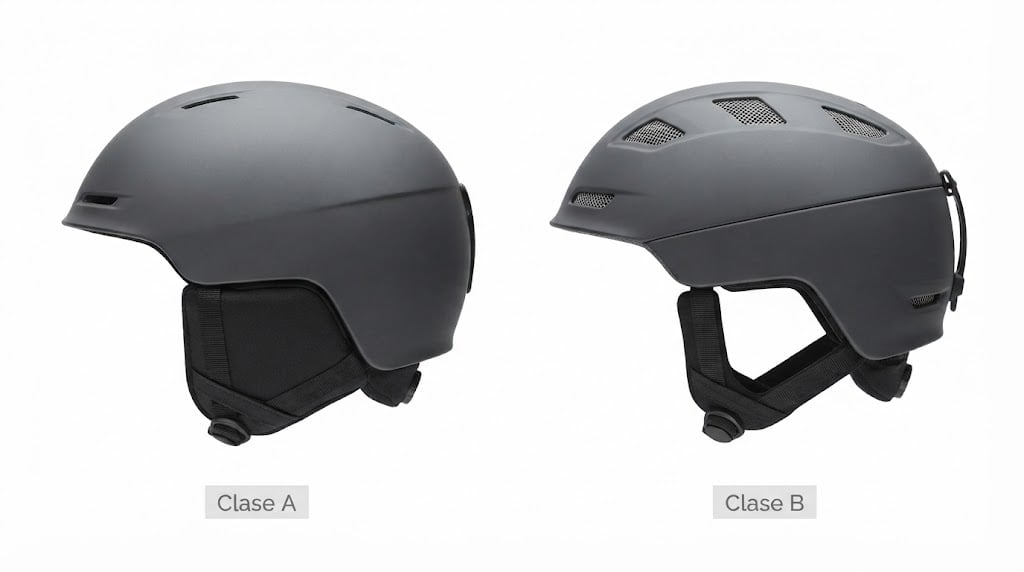
There is one practical nuance worth knowing. On a snowboard, with both feet strapped to the board, falls tend to go backwards or sideways; on skis, with your feet free, the range of falls is wider. So if you go off-piste or want maximum coverage, a Class A helmet (more coverage at the sides and over the ears) may suit you better than a Class B one (lighter and better ventilated, with less coverage) — both sit within the same CE EN 1077 standard.
Types of ski and snowboard helmet
Not every helmet is built for the same use, and picking the wrong type is a more common mistake than you'd think. Before you buy, work out which of these three groups fits what you need:
- Full-face helmets: these cover your face too and offer the most complete protection available. This is the option for freeride, racing, or any terrain where the risk of impact is higher than usual.
- Half-shell helmets: they protect the top and back of your head and leave your face free. Compatible with goggles and headphones, they're the usual — and sufficient — choice for intermediate and advanced skiing on piste.
- Hybrid helmets: they combine elements of both to give more versatile protection without giving up on weight.
What size helmet do I need?
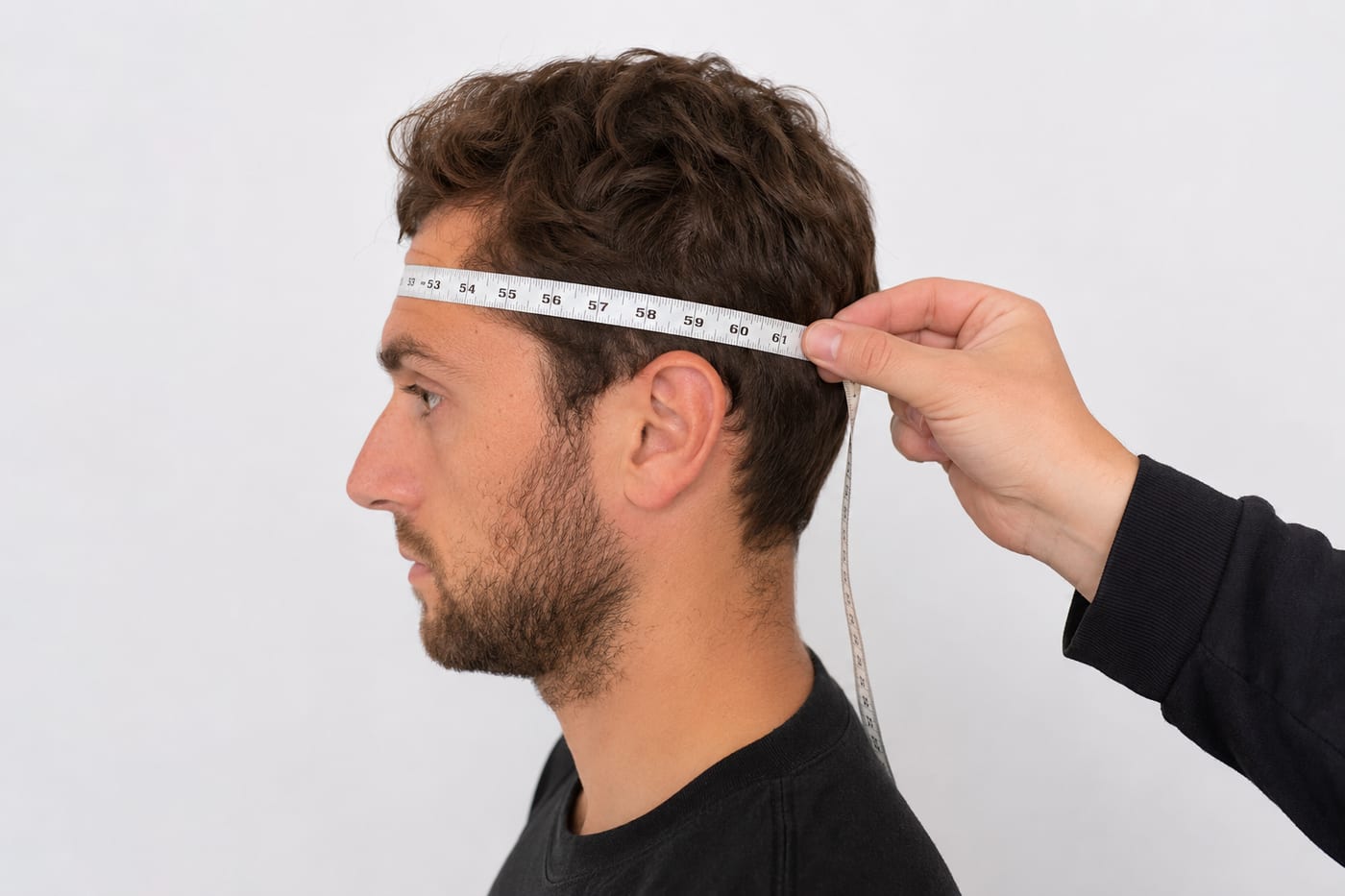
A badly fitted helmet loses much of its effectiveness, however good the technology inside it. This is by some distance the most common buying mistake. To get it right:
- Measure the circumference of your head with a tape measure, running it just above your eyebrows and ears.
- Check that specific manufacturer's size chart: it varies slightly between brands, so don't assume your usual size carries over.
- Try it on with your ski goggles. The two should sit snugly together, with no gaps and no uncomfortable pressure.
- Check the fit by moving your head firmly: the helmet shouldn't shift or feel loose at any point.
Adult helmet size chart
| Head circumference (cm) | Size |
|---|---|
| 52 - 54 cm | XS |
| 55 - 56 cm | S |
| 57 - 58 cm | M |
| 59 - 60 cm | L |
| 61 - 62 cm | XL |
Children's ski helmet size chart
| Head circumference (cm) | Size |
|---|---|
| 48 - 50 cm | XXS |
| 51 - 52 cm | XS |
| 53 - 54 cm | S |
Treat these ranges as a starting reference, not a fixed rule: always confirm the specific chart from the manufacturer you're interested in before buying. If you need kit for your next lesson, at Snow Riders Academy you can rent a helmet already fitted to your size.
Helmet and goggles: how to check they fit together
A helmet that's perfect on size can still fail if it doesn't work with your goggles. It's one of the checks people most often skip, and one of the easiest to do in the shop or before you head out.
A good fit: the goggles sit against the front of the helmet with no gap between them, the goggle strap is held properly by the system designed for it (over or under the back of the helmet, depending on the design), and you feel no pressure points on your forehead or temples when you move your head.
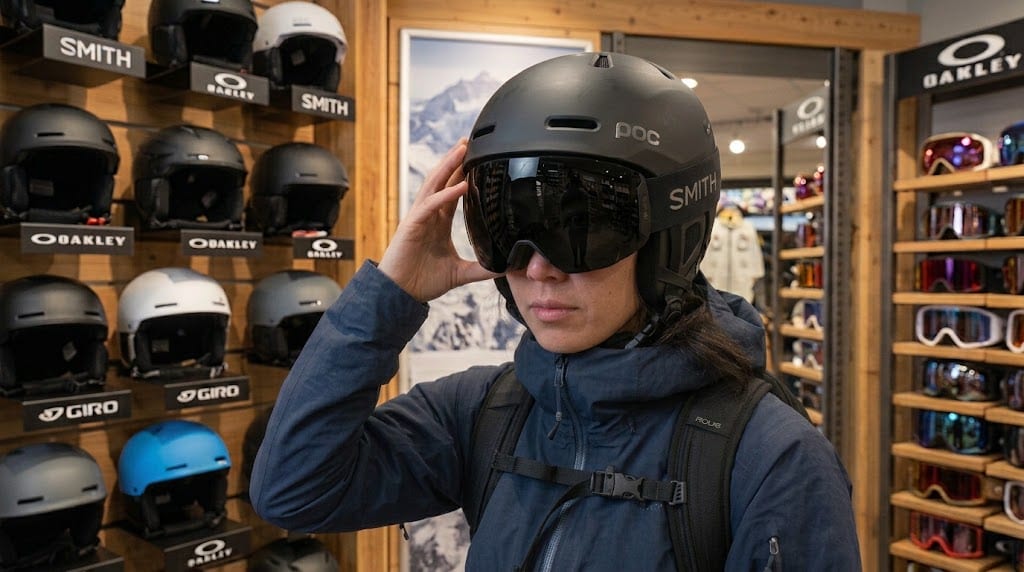
A bad fit: there's a visible gap between the top of the goggles and the helmet — which is where cold and wind get in — the goggles push the helmet upwards as you put them on, or you feel uncomfortable pressure on the bridge of your nose because the helmet sits too low.
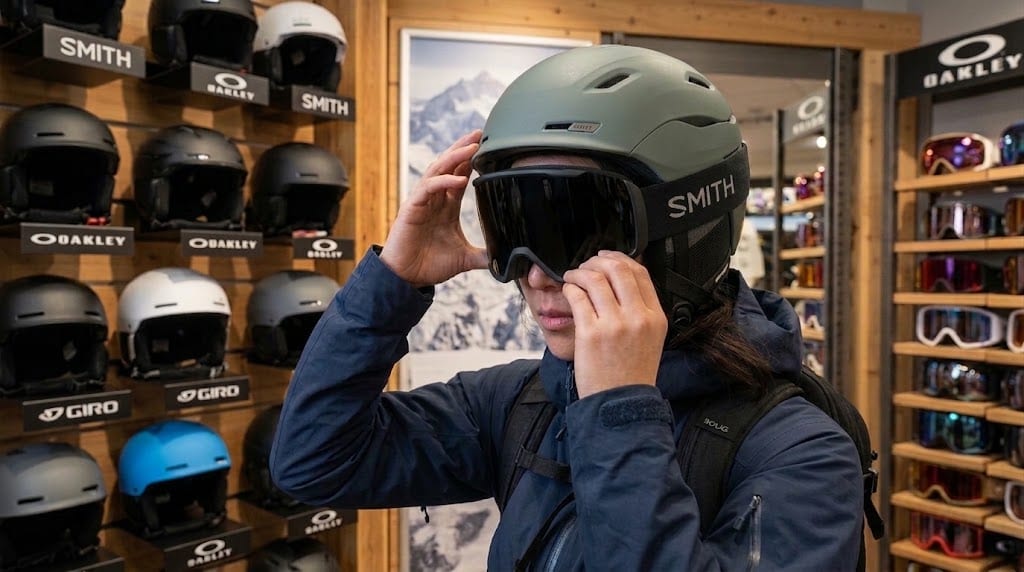
If you run into any of these, the helmet isn't always the problem: sometimes it's the goggles that don't work with that particular brand or shape. Always try the two together before buying, never separately. If you're choosing goggles too, we have a full guide to choosing ski and snowboard goggles covering lens categories, colours and technologies.
Materials and safety technologies
Shell materials
- ABS: tough and durable; the most robust option for heavy use.
- In-Mold: light and compact; prioritises comfort and fit without giving up safety.
- Hybrid (ABS + In-Mold): combines both approaches for protection that's versatile and light at the same time.
Technologies that genuinely change the safety picture
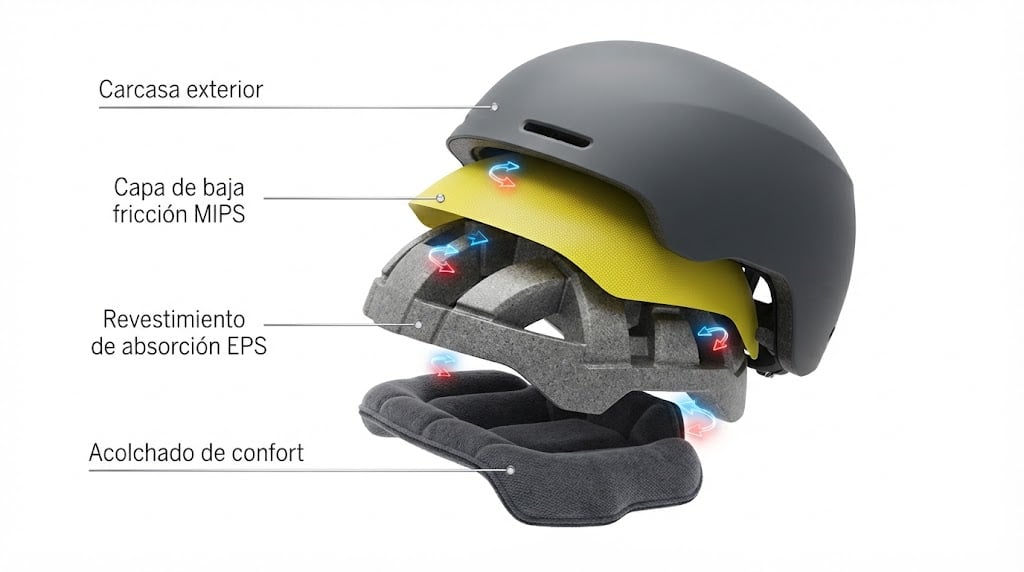
- 🌀 MIPS: a low-friction inner layer that lets the helmet move slightly against your head in an angled impact, designed to reduce the rotational movement that reaches the brain. The manufacturer itself is clear on one important point: MIPS does not guarantee you'll avoid an injury, and it doesn't let anyone claim a helmet is "X% safer" than one without it. It's an extra layer of protection, not a guarantee.
- 🛡️ Koroyd: a lightweight material that disperses energy in high-intensity impacts through a structure of collapsible tubes.
- 🏥 TwICEme: stores medical information in the helmet itself, accessible in an emergency via NFC — it requires you to register your details in their app beforehand; it does nothing without that step.
- 📡 Recco Rescue System: a passive reflector built into the helmet that a rescue team can locate with their own detector in an avalanche or a backcountry emergency. It has no battery and emits no signal by itself, and it does not replace carrying a transceiver, shovel and probe if you go off-piste: without that kit and the training to use it, a companion cannot find you with a Recco reflector alone.
Which standards does a ski helmet have to meet?
- CE EN 1077: the mandatory European certification for ski and snowboard helmets. It certifies that the helmet has passed minimum tests for impact absorption, penetration and the strength of the retention system — it isn't a guarantee that it will prevent every injury. Within the standard there are two levels: Class A (more coverage, including the ear area) and Class B (lighter and better ventilated, with slightly less coverage at the sides).
- ASTM F2040: the US certification, covering protection against impact and penetration.
- SNELL RS-98: one of the most demanding standards on the market for resistance to multiple impacts.
Before you buy, check that the helmet shows at least one of these certifications on the label inside. If it doesn't, it isn't a certified snow helmet, however good it looks on. Standards checked in August 2026 — certifications can be updated, so always confirm the current one on the manufacturer's label.
Which helmet to choose for your level
Not every skier and snowboarder needs the same kind of protection. As a starting point:
- Beginner: go for a half-shell helmet that's comfortable and well ventilated — at this level, falls tend to be at low speed on groomed pistes. CE EN 1077 is the minimum to accept, and you don't need advanced technologies yet. If you're just starting out, take a look at our beginner ski and snowboard lessons.
- Intermediate: this is a good moment to consider MIPS if your budget allows, especially as you start carrying more speed or trying red runs.
- Advanced: alongside MIPS, a Class A helmet (more coverage at the sides) starts to make sense if you're after speed or more technical pistes, as in our carving lessons.
- Freeride: here protection should be at its maximum. A full-face or Class A helmet with technologies like MIPS and Recco is what we'd recommend for off-piste terrain — always alongside a transceiver, shovel and probe, never as a substitute for that kit. If you want to work towards it, see our freeride lessons.
How to choose a helmet for a child
Choosing a helmet for a child has its own rules, beyond reading a size chart:
- Don't buy a size up "so it lasts": a loose helmet moves in a fall and loses much of its protection. Better to buy the right size now and change it when the time comes.
- Children's heads grow fast: check the fit at the start of every season, not just when you buy the helmet. If it no longer sits snugly without tightening the strap to its limit, it's time to change it.
- Second-hand helmets, with care: a helmet absorbs impacts even when there's no visible damage. If you don't know its full history, it isn't the best option for a child's head.
- The fit before a lesson matters: check that the child can move their head freely, that the strap is firm but not uncomfortable under the chin, and that they can see properly with their goggles on.
If your child is taking their first lessons with us, take a look at our kids' ski and snowboard lessons.
The parts of a ski and snowboard helmet
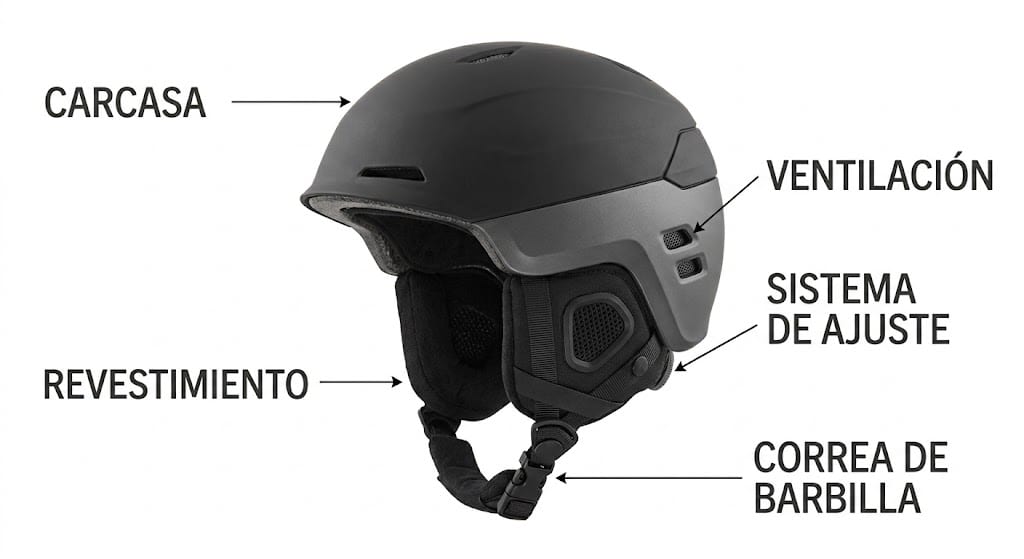
- Shell: the outer layer that protects against knocks and scrapes.
- Liner: the inner part that absorbs the impact.
- Adjustment system: lets you fine-tune the fit for comfort and safety.
- Ventilation: openings that regulate airflow and stop you overheating.
- Chin strap: keeps the helmet in place without being uncomfortable.
Care, maintenance and when to replace your helmet
- Regular cleaning: use a soft cloth with warm water and mild soap on the outside.
- Storage: keep it somewhere cool and dry, out of direct sunlight.
- When to replace it: manufacturers generally recommend replacing it every 5 years at most, or straight away after a hard impact, even if you can't see any damage. The materials that absorb the blow lose effectiveness even when the shell looks intact from the outside.
Before you buy: a quick checklist
- Visible certification: at least CE EN 1077.
- Size based on your actual measurement, not your "usual" size in other kit.
- Compatible with your ski goggles, with no gaps and no pressure.
- Safety technology matched to your level: MIPS if you want extra protection against rotational impacts.
- If you go off-piste, don't rely on Recco alone: carry a transceiver, shovel and probe, and the training to use them.
- If it's second-hand, confirm how old it is: a helmet doesn't age well and loses effectiveness over time, even when it looks untouched.
A well-chosen ski or snowboard helmet meets three conditions at once: a real safety standard, a size fitted with no margin for error, and technology matched to how and where you ride. With this guide you have all three criteria clear, so you can buy with confidence and enjoy the mountain knowing your head is as well prepared as the rest of your kit.