
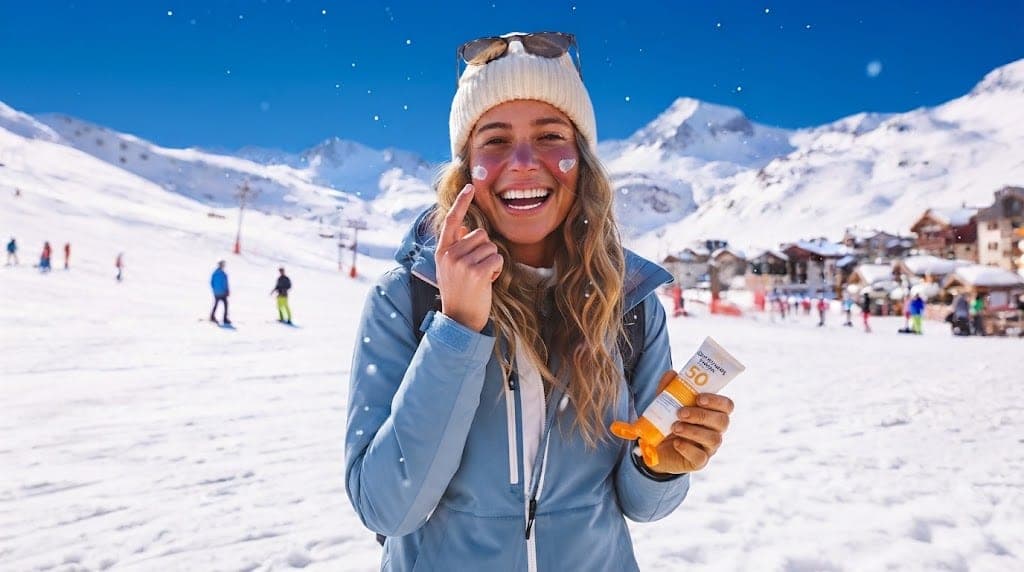
Sun protection is the last thing most people put in the bag and the first thing they wish they'd brought once they're off the mountain. Skiing or snowboarding exposes you to considerably more ultraviolet radiation than a day at the beach, with one thing that makes it worse: it's cold, you don't feel yourself burning, and you keep riding lifts until the damage is done. This guide brings together what's genuinely worth knowing before you buy and before you head out: why snow changes the rules, what the numbers on the bottle mean, how much you actually need, and which spots burn even when you think they're covered.
In short: on snow, an SPF 50 broad-spectrum sunscreen — with the UVA seal on the bottle — and water resistant. Put it on about 30 minutes before you head out and reapply every two hours. What usually fails isn't the number on the bottle but the amount: you need around half a teaspoon for face and neck alone. And don't forget your lips, ears, and the underside of your nose and chin, which take the reflection off the snow from below.
Why sun on snow plays by different rules
Two effects stack up, and neither is obvious when you're cold.
The first is altitude. According to the World Health Organization, ultraviolet radiation increases by around 10% for every 1,000 metres of elevation. Worth clearing up a widespread misunderstanding: it isn't because you're closer to the sun — that difference in distance is irrelevant — but because there's less atmosphere above you to absorb the radiation.
The second is reflection. Fresh snow is an exceptional reflector: it sends back up to 80% of the UV radiation it receives, effectively doubling your exposure. That's why on snow you burn in places you never burn in summer, starting with the underside of your nose and chin.
In Sierra Nevada both factors apply at once, and strongly. The resort starts at Pradollano at around 2,100 metres and rises above 3,300 at the top: it's the highest resort in Spain and also the most southerly in Europe, which puts the sun higher in the sky than in the Alps. A clear March day at Borreguiles, with fresh snow and the sun hitting from above and below, is a far more demanding radiation environment than the thermometer suggests.
And two ideas worth dismantling once and for all:
- Cold doesn't protect you. How warm it feels has no relationship at all with how much radiation reaches you. In fact that's exactly what makes exposure on snow dangerous: you burn without the warning signal of heat.
- Nor do cloudy days. Light cloud barely reduces radiation and, through scattering, can in some cases even increase it. A foggy day or one with high cloud at the resort is not a day without sun protection.
What do SPF and the UVA symbol on the bottle mean?
This is where the misunderstandings pile up, and where reading it wrong costs you a burn.
SPF is not a stopwatch
This is the most widespread confusion and the most important to undo: SPF does not tell you how long you can stay in the sun, and it doesn't multiply by any number of minutes. It's a ratio: it measures how much more ultraviolet B radiation it takes to redden protected skin compared with unprotected skin, measured in a lab with a specific quantity of product.
That rule of "multiply the factor by how long it takes you to burn" is discredited because on the hill none of the lab conditions hold: intensity changes with the time of day and the altitude, you sweat, you touch your face, you rub against your collar, and the product degrades. The practical consequence is simple: reapply every two hours, whatever the factor.
What the number does tell you is how much UVB it filters:
| Factor | UVB radiation filtered (approx.) |
|---|---|
| SPF 15 | 93% |
| SPF 30 | 97% |
| SPF 50 | 98% |
As you can see, going from 30 to 50 doesn't double the protection. But in extreme exposure like snow that last percentage point does matter, and what matters most is the margin it leaves you when — as always happens — you apply less than you should. On the mountain, SPF 50.
The UVA circle
SPF only speaks to UVB, the radiation that burns. UVA penetrates more deeply and is the one associated with premature skin ageing, so you need a broad-spectrum product.
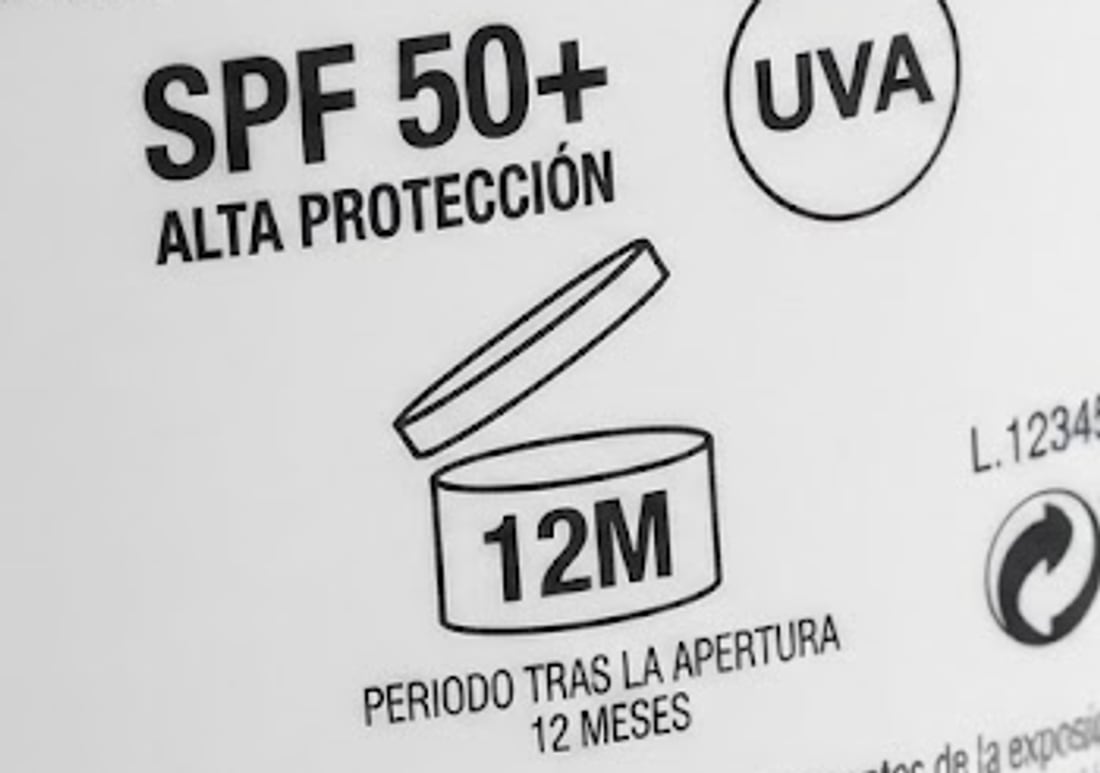
In Europe that's identified by the "UVA" logo inside a circle. European Commission Recommendation 2006/647/EC establishes that a product carrying it must offer UVA protection of at least a third of the stated SPF and a critical wavelength of at least 370 nanometres. One honest caveat: it's a recommendation, not binding regulation, and the seal is voluntary. In practice most serious brands sold in the EU meet it and display it; if a bottle doesn't carry it, that's reason enough to move on to the next one.
"Water resistant" has a specific meaning
It doesn't mean it lasts all day. Products are tested with timed immersions following the Cosmetics Europe guidelines and the corresponding ISO standards:
- Water resistant: keeps at least half its protection after 40 minutes.
- Very water resistant: keeps it after 80 minutes.
Skiing and snowboarding you aren't swimming, but you do sweat under several layers and fall in the snow, so water resistance is still a real buying criterion — and it still doesn't excuse you from reapplying.
The PAO symbol
The open jar with a number and an "M" — 12M, 24M — is the period after opening: the number of months the product keeps its properties once opened. Last year's sunscreen that's been in the glovebox since July doesn't protect the way the label says, and that's as common a kit mistake as wearing the wrong size.
How much and when: what actually makes the difference
If you take only one idea from this guide, make it this one: the amount matters more than the number on the bottle.
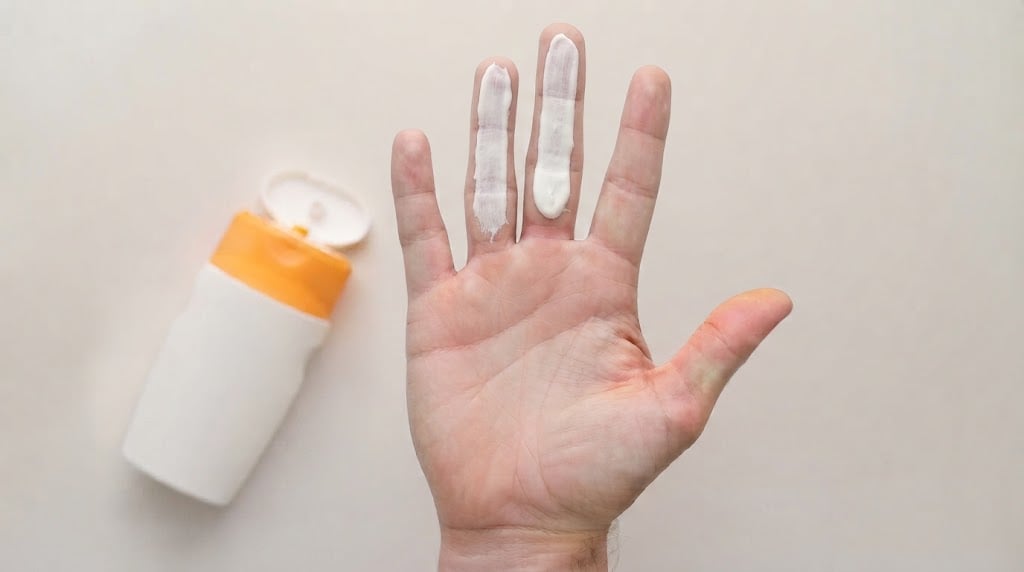
SPF testing is done applying 2 mg of product per square centimetre of skin, which works out at roughly half a teaspoon for face and neck alone. If you apply half of that, the real protection doesn't drop by half: it falls much further, and an SPF 50 can end up performing well below what the bottle claims. Most people apply between a quarter and a third of what's needed, which explains why burns are still so common among people convinced they were protected.
A practical way to measure it without a spoon is the two-finger rule: the amount that fits along your index and middle fingers together, from the tip to the first crease, covers face and neck.
On timing:
- Apply about 30 minutes before you head out, indoors or in the car, not in the gondola queue with cold hands.
- Reapply every two hours. In practice, the mid-morning stop and lunch are the two natural moments.
- Reapply after sweating heavily, after a face-first fall, or after wiping your face with your buff, which takes a good deal of the product with it.
Types of sunscreen and what suits the mountain
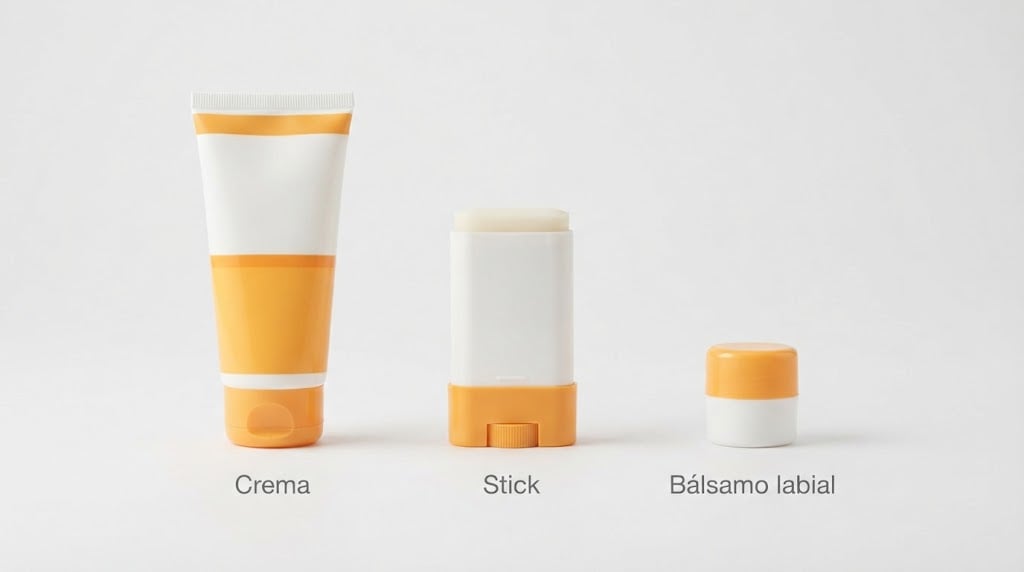
- Cream: the main option. Thicker formulas work better in cold, which dries skin badly, and hold up well in wind.
- Stick: very useful as a top-up on the nose, cheekbones and ears. You can reapply without fully taking your gloves off and it doesn't drip, so it's the format you actually end up using on the chairlift.
- Gel or fluid: lighter and quicker to absorb. A good option for oily skin, though on very cold days they can fall short on hydration.
- Spray: convenient, but easy to apply in insufficient quantity. If you use one, apply generously and spread it with your hand; and avoid using it in wind, because much of the product never reaches your skin.
- SPF powders: fine as a touch-up over a base you've already applied, not as your main protection.
- SPF lip balm: not optional. Lips produce almost no melanin, they're fully exposed to the reflection from below, and they crack in cold and wind. They also lose it when you drink and eat, so it needs reapplying far more often than cream. Keep it in a chest pocket, not in your bag.
Physical or chemical filters
Mineral filters (zinc oxide, titanium dioxide) act mostly on the surface of the skin and are usually better tolerated by sensitive skin and by children. Organic filters, which are more common, absorb the radiation and allow lighter, less chalky textures, although they're the ones most often associated with irritation or contact allergies — which in any case are uncommon.
One cliché worth dismantling: minerals don't protect more for being mineral. The protection comes from the factor and, above all, from how much you apply. Choosing between them is mostly a question of what your skin tolerates and which texture you'll genuinely put on every day.
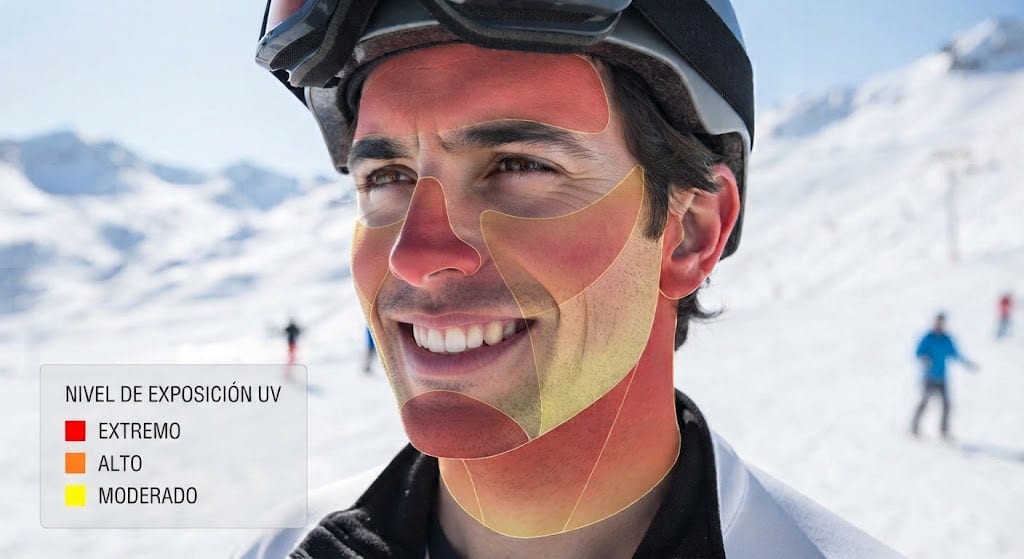
The spots that burn most while skiing
On snow the radiation doesn't only come from above: it bounces. That completely changes the map of exposed areas compared with any other outdoor sport.
- Underside of the nose, chin and the neck below the jaw: the great forgotten ones. In summer they're in shade; on snow they take the reflection head-on.
- Cheekbones and forehead: the band between your goggles and your helmet or hat is where burns concentrate most.
- Lips: SPF balm, reapplied often.
- Ears: if you aren't wearing a helmet or hat that covers them, they burn every time.
- Neck and nape: especially once you unzip your midlayer at midday.
- Hands and wrists: the strip left exposed between glove and sleeve if the cuff is short — a problem you also solve by choosing the glove well, as we explain in the guide to choosing ski and snowboard gloves.
- Your parting: if you ski without a helmet. One more argument, among many, for wearing one.
On areas covered by clothing: in general they don't need sunscreen, but one caveat is worth adding. Thin, heavily stretched or wet fabrics let through considerably more radiation than you'd think, so a thin technical tee isn't a complete barrier.
Your eyes burn too
Reflected radiation doesn't only affect skin. Intense exposure without eye protection can cause photokeratitis — what's popularly called snow blindness — which is literally a burn on the cornea: it doesn't hurt at the time, it appears several hours later, and it's fairly disabling.
It's the reason goggles or sunglasses aren't a style accessory on the mountain, and why the UV400 marking matters more than the colour of the lens. We go into it in the guide to choosing ski and snowboard goggles.
Sun protection for children
With children all of this weighs more: their skin is thinner, sun damage accumulates over a lifetime, and they won't tell you they're burning until it already stings.
- SPF 50 always, and preferably with mineral filters, which are usually better tolerated.
- Apply before you dress them, calmly, indoors. Once the suit is on and the mittens are done up there's no way.
- A stick in the instructor's pocket or yours for the mid-morning top-up on face and ears.
- Lip balm, which children's lips need sooner.
- A hat or helmet that covers the ears, which is the area most often forgotten.
If your children are taking lessons with us, it's one of the things we check at the mid-morning stop during our kids' ski lessons in Sierra Nevada.
Storage: where not to keep the bottle
- Don't leave it in the car. The heat inside degrades the filters, and that's exactly where most bottles end up between one weekend and the next.
- Watch extreme cold in a bag left in the boot: freeze-thaw cycles can alter the emulsion and separate the product.
- Check the PAO and the expiry date at the start of the season. A sunscreen opened last season is, in all likelihood, one that no longer delivers the factor it promises.
- Carry the small format on you, not in the bag you leave in a locker: the reapplication that requires a trip back to the changing room is the one that never happens.
Before you buy: a quick checklist
- SPF 50 and broad spectrum, with the UVA logo inside a circle visible on the bottle.
- Water resistant, for the sweat under your layers and the falls in snow.
- A stick format as well as the bottle, so you can reapply on the chairlift without taking your gloves off.
- SPF lip balm, in a pocket you can reach.
- Mineral filters if your skin is sensitive, or if it's for a child.
- Check the PAO symbol and bin last season's bottle.
- A texture you're willing to put on every day: the best sunscreen is the one you actually apply, in the right amount.
Sun protection is, along with goggles, the cheapest kit of your whole day on snow and the one with the longest-lasting effect on you: sun damage accumulates and doesn't reverse. With a broad-spectrum SPF 50, the right amount and a mid-morning reapplication, you've covered the essentials. The rest is enjoying a sunny day in Sierra Nevada, which is one of the best things about skiing here.