
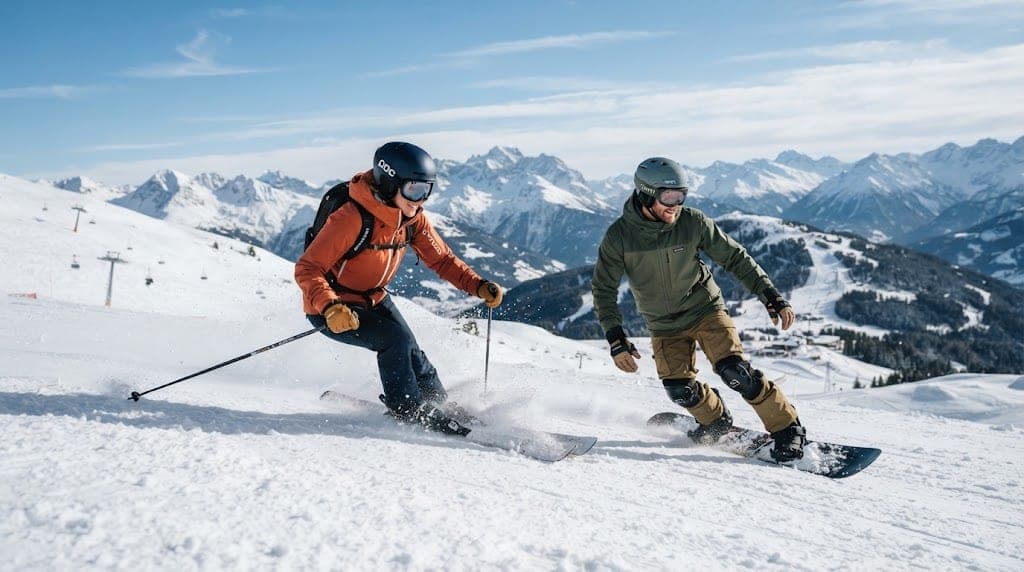
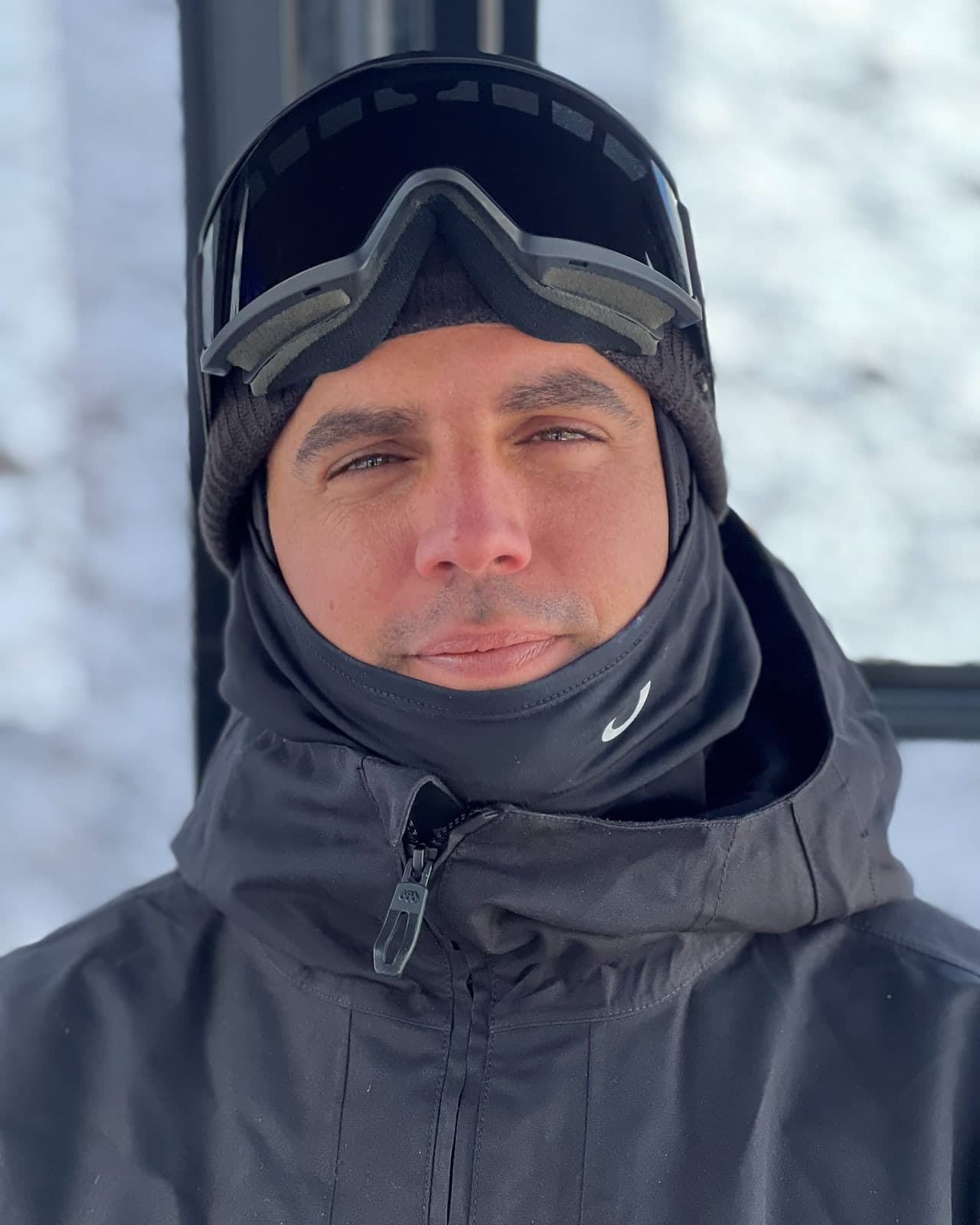
The list of protective gear you can buy for the snow is long, and buying all of it is neither necessary nor comfortable: every piece you add costs you some mobility, and mobility is part of safety too. The useful question isn't "what protection exists" but "which do I need, for my sport, my level and what I actually do on the hill". That's what this guide is about: what each piece protects, which standard it should meet, and when it's genuinely worth it.
In short: the helmet is non-negotiable for everyone. Beyond that it depends on how you fall: if you're starting snowboarding, wrist guards and impact shorts are the two you'll notice most; if you ride freestyle or go off-piste, the back protector; and if you ski on piste, a helmet and a back protector have you well covered. Always check the certification — EN 1621-2 on back protectors, EN 14120 on wrist guards — and try the size in the clothes you'll be wearing.
It all depends on how you fall
This is the criterion that orders the rest of the guide, and it's almost never explained: skiing and snowboarding don't produce the same falls, so they don't need the same protection.
On a snowboard both feet are strapped to the board. You can't take a step to recover your balance, so falls go backwards — onto your back and tailbone — or forwards onto your hands. Which is why the two most worthwhile pieces are precisely the ones almost nobody buys: wrist guards and impact shorts.
On skis your feet are free and the bindings release, so the range of falls is wider and your hand doesn't act as a shock absorber in the same way. Here the focus is on your head and your spine, especially if you carry speed or jump.
And in both cases there's a factor that weighs more than the sport: your level. Beginners fall far more, fall worse and fall in more predictable ways. That's why the protection we'd recommend to someone starting out isn't the same as for someone ten seasons in.
Which protection you need, by profile
| Profile | Essential | Strongly recommended | Optional |
|---|---|---|---|
| Snowboard beginner | Helmet | Wrist guards and impact shorts | Back protector |
| Ski beginner | Helmet | — | Back protector |
| On-piste skiing, intermediate or advanced | Helmet | Back protector | — |
| Freestyle and snowpark | Helmet and back protector | Wrist guards, impact shorts | Body armour, knee pads |
| Jibbing on features | Helmet and back protector | Knee and shin pads | Body armour |
| Freeride and off-piste | Helmet and back protector | — | Body armour |
Off-piste there's also a separate category that isn't "protection" in this sense and shouldn't be confused with it: a transceiver, shovel and probe, plus the training to use them. They don't cushion a blow; they're for finding someone buried by an avalanche. No impact protection substitutes for that kit, or for the judgement about where and when you drop in.
The helmet
It's the only piece we recommend without qualification to everyone, in both sports and at every level, and it's mandatory to enter the snowpark and the freeride areas at most resorts.
Since it's worth a whole guide of its own — sizes, class A and B, MIPS, CE EN 1077 certification — we cover it in the guide to choosing a ski or snowboard helmet.
Wrist guards
The best ratio of cost to inconvenience to injuries avoided, and probably the most ignored piece there is.
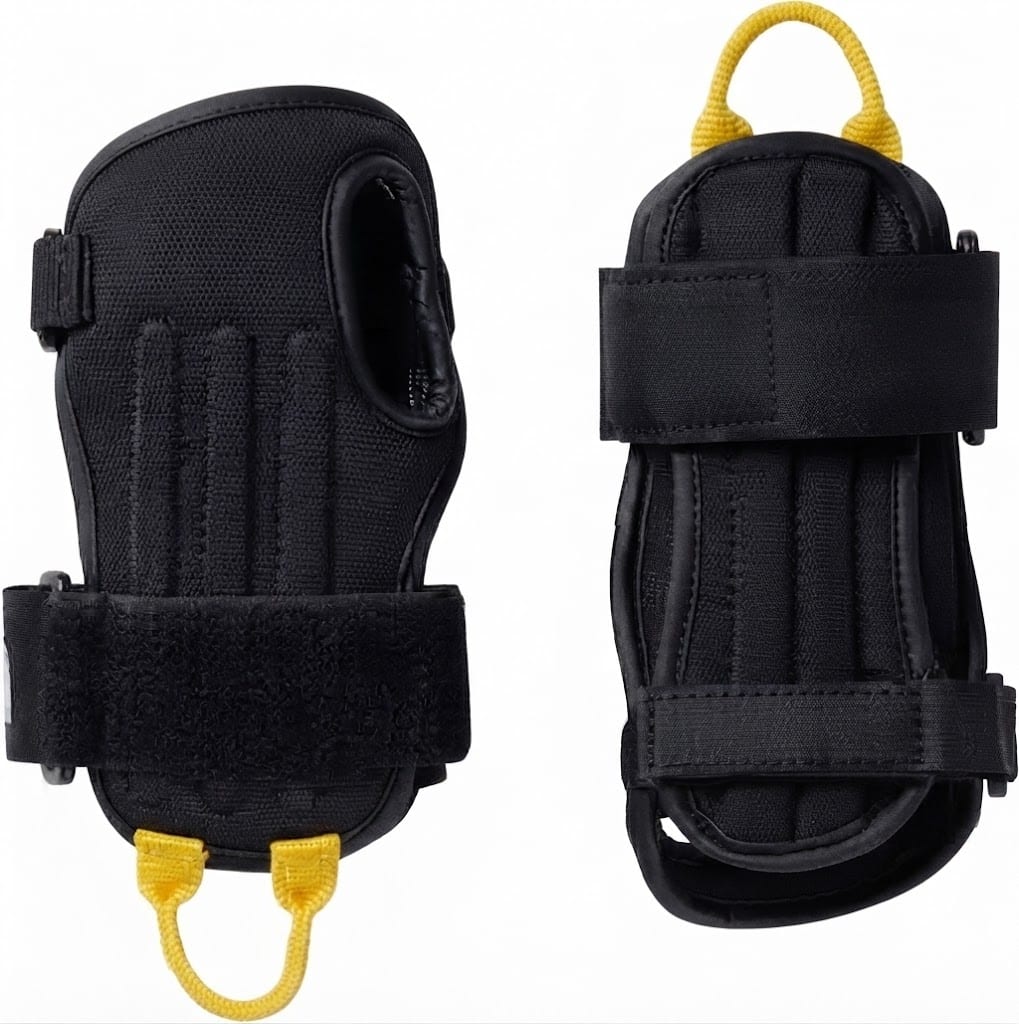
The reason is the mechanics of a snowboard fall: with your feet strapped in, the automatic reflex is to break your fall with your hands, and a hyperextended wrist is exactly the position in which it breaks. Published systematic reviews suggest that wrist guards reduce the risk of wrist injury in snowboarding, although the authors themselves ask for caution because the quality of the available studies is limited. What does appear more consistently is a fact that matters a great deal to beginners: snowboarders with fewer than five days' experience injure their wrists considerably more often than those further along.
What to look for:
- That they have a splint, the rigid strip that stops the wrist bending backwards. Without it, it's a nice-looking sleeve.
- Compatibility with your glove: there are versions to wear under, over, or built into the glove itself. The integrated one is the most comfortable and the one you'll actually wear, although it narrows your choice of glove.
- That they don't restrict circulation with the glove already on over them. Try the whole lot together, not the guard on its own.
On skis they matter far less, because your hand doesn't take the blow the same way and you're holding poles.
Impact shorts (tailbone protection)
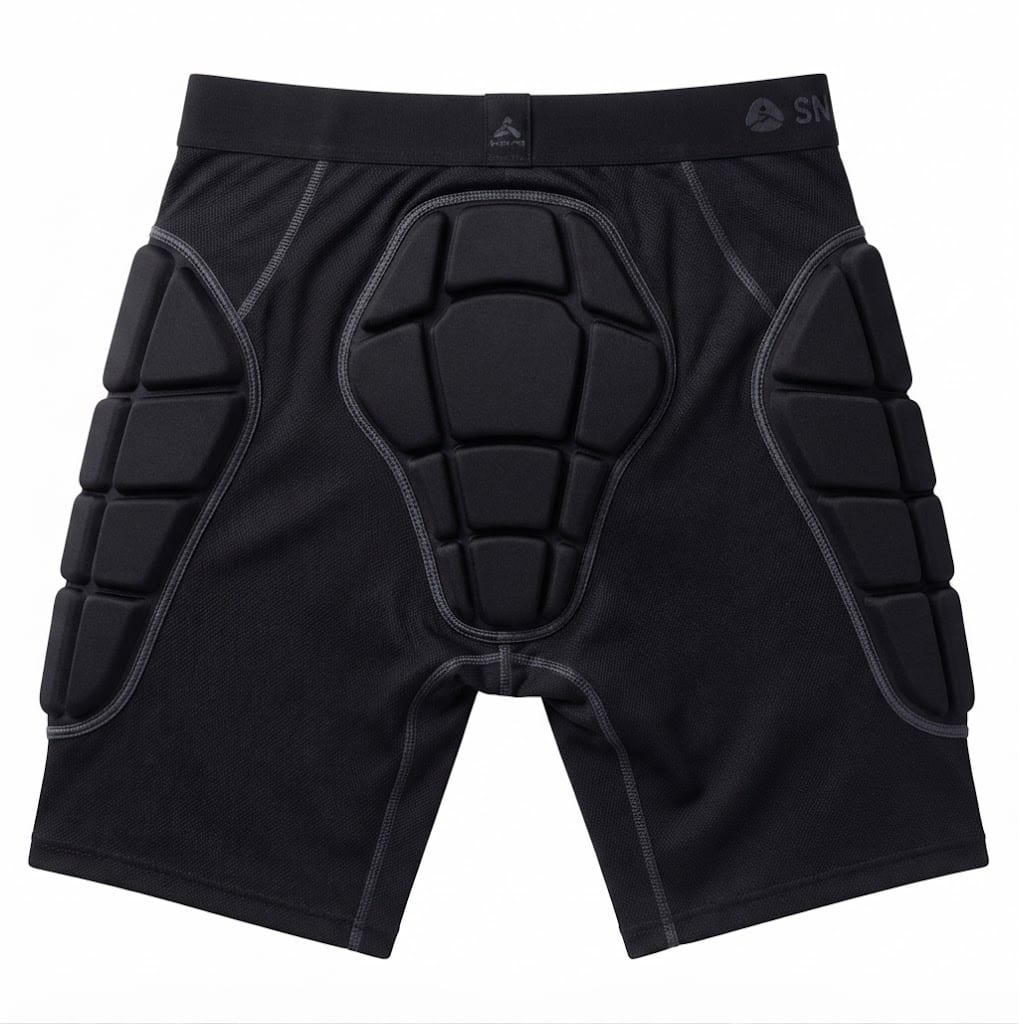
A pair of shorts or a base layer with padding over the tailbone, hips and sometimes thighs, worn under your trousers.
This is the most specifically snowboard piece there is, for one very concrete reason: learning to control your heel edge you go down on your backside over and over, and your tailbone hits hard snow directly. A tailbone bruise usually isn't serious, but it hurts for weeks and takes you out for the rest of the trip — which for someone who came to Sierra Nevada for five days means losing the whole course.
If you're starting snowboarding, it's one of the purchases you'll be most grateful for. We talk about it with everyone who comes to our snowboard lessons in Sierra Nevada, because falling backwards is an unavoidable part of learning.
Back protector
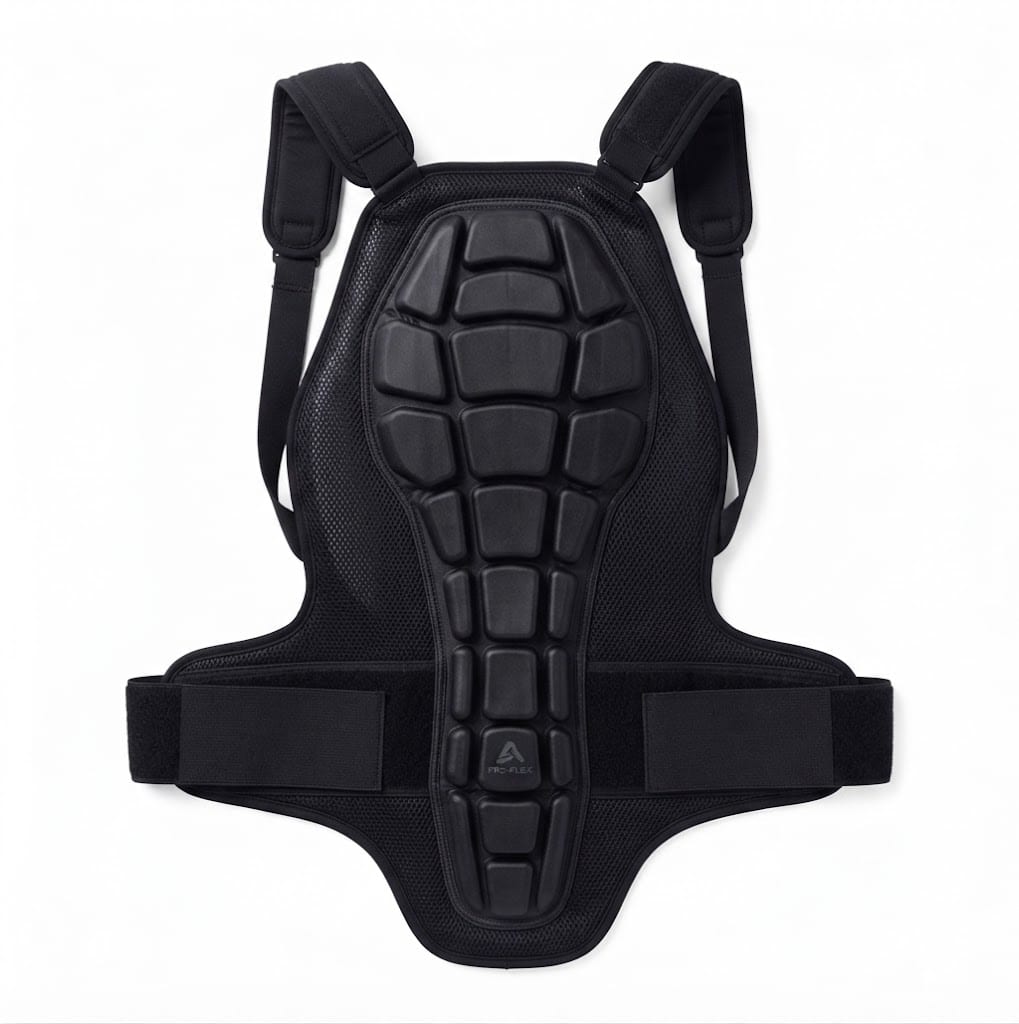
Protects your spine by spreading the energy of an impact along your back. It's the reference piece for freestyle and freeride, and a sensible purchase for anyone carrying speed.
Formats: harness style, held on with shoulder straps and a waist belt, and built into a shirt or vest, which is more comfortable and doesn't shift, but warmer.
There's an important nuance here that almost nobody mentions and is worth understanding before you buy: a cheap back protector, or one in the wrong size, costs you a fair amount of mobility, and on snow mobility is part of your safety. A back protector that won't let you bend at the waist will make you ski worse. Try it sitting, crouching and twisting, in the clothes you'll be wearing.
Body armour
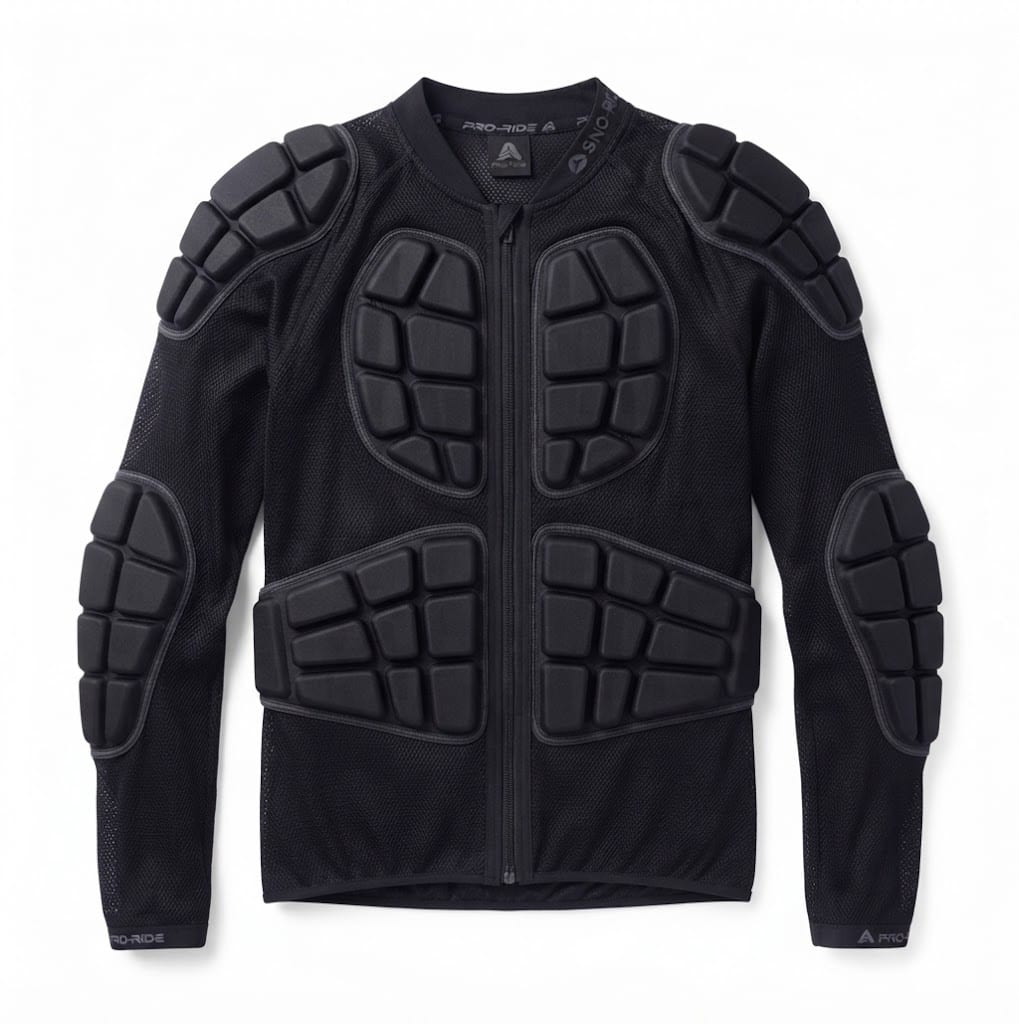
Full body armour protects your torso and upper body. There are sleeveless versions — chest, abdomen and back — and sleeved ones, which add shoulders and elbows.
One warning to avoid confusion when shopping: in snow clothing, "bib" also refers to trousers with braces, which protect nothing at all. If you're after protection, search for "body armour" or "torso protector".
This is advanced freestyle, jibbing and racing kit. For skiing or snowboarding on piste it's more protection than you need and considerably more heat than you want.
Knee and shin pads
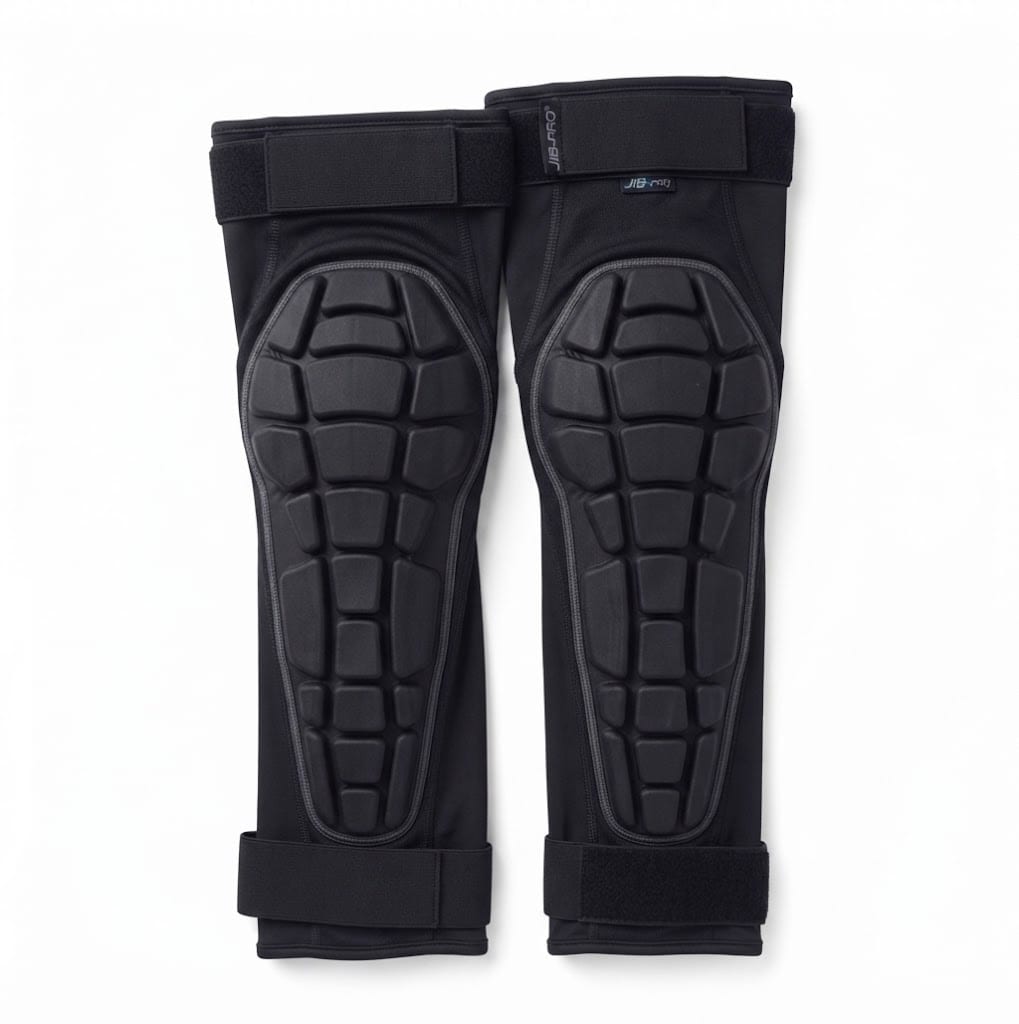
Useful in two specific cases: jibbing — sliding on boxes and metal rails, where blows to the shins are constant — and snowboard beginners who spend a lot of time on their knees in the snow.
Outside those two cases we don't recommend them: they limit knee flexion, which is the movement all technique in both sports is built on. Trading technique for protection you probably won't need is a bad deal.
Which standard should each piece meet?
This is the part that separates real protection from a foam shoulder pad, and it's worth checking before the brand or the colour.
| Protection | Standard | What it means |
|---|---|---|
| Helmet | CE EN 1077 | The European standard specific to alpine ski and snowboard helmets. Class A (more coverage) and class B (lighter and better ventilated). |
| Back protector | CE EN 1621-2 | Level 1: transmits at most 18 kN. Level 2: at most 9 kN, roughly half the residual energy. |
| Wrist guards | CE EN 14120 | The European standard for protectors in roller sports, which is also the one applied to snowboard wrist guards. |
On back protectors there's a detail that surprises many people and explains a common question: there is no European standard specific to ski or snowboard back protectors. EN 1621-2 is the motorcycling standard, and snow manufacturers adopt it because it's the available reference. Which is why a snow back protector genuinely works for a motorbike or a mountain bike: it's certified under the same standard. What changes between disciplines is the cut and the ventilation, not the impact test.
Materials and technologies
- D3O: a material that stays flexible at rest and hardens instantly on impact. Widely used in back protectors and body armour because it allows protection with very little thickness.
- SAS-TEC: a viscoelastic memory foam able to absorb repeated impacts without losing performance.
- EPS and EPP: expanded polystyrene and polypropylene foams that disperse the energy of a blow. EPS is the reference material inside helmets; EPP tolerates repeated impacts better.
- Koroyd: a very light structure of welded tubes that absorbs energy by crushing in a controlled way, and lets air through as well.
- Silicone gel: used in high-movement areas, where what matters most is that the protection follows the body.
- Aramids: high-strength synthetic fibres used in outer layers to resist abrasion and tearing. Kevlar is the best-known aramid: it's a brand name for this kind of fibre, not a different material.
- MIPS: a sliding layer that reduces rotational forces in angled impacts. It's helmet technology, not body protection, and we explain it in detail in the helmet guide.
Care and when to replace them
- After a hard impact, check them. Foams absorb the blow by deforming, and once deformed they no longer protect the same even if they look intact from the outside. Viscoelastic materials like SAS-TEC tolerate repeated impacts; rigid foams don't.
- Always dry them before putting them away. They're worn against the body, they end up soaked in sweat, and storing them damp degrades both the fabrics and the straps.
- Check fastenings and velcro at the start of the season. A back protector that shifts isn't protecting the area it should.
- Replace them if you see cracks, compressed foam or velcro that no longer holds. With reasonable use they last several seasons, but they aren't forever.
- Be careful with second-hand: you can't know how many impacts they've taken, which is exactly the fact that determines whether they still work.
On rentals: resorts commonly have rental helmets, while wrist guards, impact shorts and back protectors tend to be personal kit, because the fit is what makes them work. If you need equipment for your lesson, ask us what's available before buying anything.
Before you buy: a quick checklist
- A helmet always, with CE EN 1077 certification visible.
- Starting snowboarding: wrist guards with a splint, and impact shorts, in that order.
- A back protector certified to CE EN 1621-2, level 1 or level 2 depending on how exposed you'll be.
- Try the size in your clothes, sitting and twisting, not standing in front of a mirror.
- Make sure it lets you move: protection that blocks your technique makes you ski worse.
- If you go off-piste, a transceiver, shovel and probe are a different thing and aren't replaced by protection.
- Before buying everything, ask yourself what you actually do on the hill: most people need two or three pieces, not seven.
In the end, the best combination of protection isn't the most complete one but the one you'll put on every day without thinking about it. A helmet for everyone; wrist guards and impact shorts if you're starting snowboarding; a back protector if you carry speed, jump or go off-piste. That covers the vast majority of real falls, without going down the mountain dressed like an American football player.